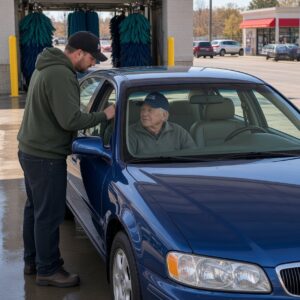
Harold let go of my wrist and asked me to sit with him on the bench beside the vacuum stations. His wife, Eleanor, had washed that Buick every Friday at 6:40 for thirty years, he explained, because it was the one chore she refused to share. When she died six months earlier, he kept the ritual alive. He told me that if he stopped, the whole town would nod sadly and say she was gone, and he wasn’t ready to hear it.
“Then who was the woman in your car last week?” I asked. He smiled for the first time. “Margaret, her twin sister. She drove down from Edinburgh to see the ritual for herself. She wears Eleanor’s pearl earrings, and she is almost completely deaf, which is why she only smiled at you.” He admitted the two washes was an old joke between him and Eleanor, who always insisted the car needed another. The Friday he missed, Margaret had taken ill, and he spent the morning at the hospital. The card had slipped from his pocket.
He pulled a folded letter from his jacket. “I found this in the glovebox last night, in Eleanor’s handwriting. She asked me to stop washing a clean car and drive to Whitby, where we spent our honeymoon. She wanted her ashes scattered from the pier, and she wrote that the Buick should get properly dirty on the way.” His voice broke, and he laughed through it. “Six months I hid behind a routine she never wanted me to keep.”
Margaret arrived in a taxi moments later and squeezed his arm. I pushed his nine pounds back into his hand and told him this last wash was on me. He shook his head, then nodded, and the Buick rolled through one final time. A month later, a postcard arrived, showing the Buick caked in mud beside a seaside pier. On the back, in shaky writing, it said the car needed another wash. I pinned it above the payment machine, and I finally understood the woman had been real all along.